Plant Physiology & The 3 Leaf Theory
The 3 Leaf Theory
In the UK, perennial ryegrass is the most widespread species of grass for grazing animals. A ryegrass ley is made up of many ryegrass plants, which in turn are made up of tillers. Each tiller is a basal stem, and up to three growing leaves. The premise of the 3 Leaf Theory is that a ryegrass tiller will only support 3 live leaves at a time.
A ryegrass tiller will only support 3 live leaves at a time. A mother tiller will produce daughter tillers, which share the same rooting space.
As a fourth new leaf is produced, the oldest leaf starts to die. When a fifth leaf is produced, the second leaf dies and so on.
What appears to be one ryegrass plant is an amalgamation of mother and daughter tillers, sharing the same rooting space. Ryegrass populations typically have between 3000 to 5000 tillers per square metre.
Perennial ryegrass plants will produce new tillers throughout the growing season with peak production occurring from late April to July. The time it takes for a tiller to produce 3 leaves will vary, depending on growing conditions.
At peak growth, it can take a tiller as little as 5 days to product a new leaf, or 15 days to reach the 3 leaf stage. In colder periods, leaf emergence can take upwards of 17 days per leaf, or 50 days to reach the 3 leaf stage.
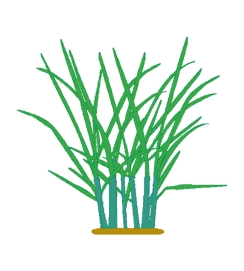
Ryegrass Clump
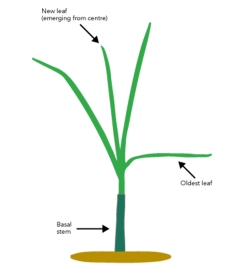
Ryegrass Tiller
In mid spring it may take 15 days for a tiller to produce three leaves, with a new leaf produced every five days thereafter. In colder periods, it may take up to 50 days for a tiller to reach the three-leaf stage, with a new leaf produced every 17 days.
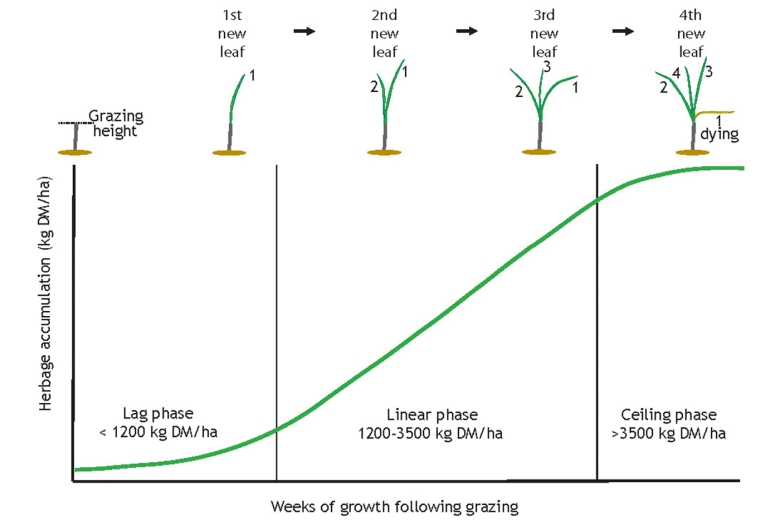
Tiller leaf production
Typically, fields grow in 3 phases, working in line with tiller production and energy reserves:
- The lag phase – where grass is less than 1200kg DM/ha
- The linear phase – where grass is between 1200 and 3500kg DM/ha
- The ceiling phase – where grass is above 3500kg DM/ha.
During the lag phase the tiller is using energy reserves stored in the bottom 5cm of the above-ground plant to furnish the growth of its first leaf. In the linear phase the second and third leaves develop, at an increased rate because photosynthesis can be used to power further leaf development. In the ceiling phase the fourth leaf develops, and the first leaf starts to die off, meaning that there is little gain in biomass, and the beginnings of reduction in stand quality.
Additionally, the accumulation of dying older leaves can create an ideal environment for fungal disease proliferation.
Three phases of grassland development
When striving for peak grass performance, the aim should be to maintain grass growth in the linear phase of development, as this is the most efficient stage of grass growth, where stand quality and growth rates are high.
Taking advantage of the linear phase means not grazing or cutting too low, leaving the plant sufficient energy reserves to grow the first leaf, as well as resting plants long enough to replenish energy reserves ahead of the next defoliation. It also means cutting or grazing relatively frequently before bottom leaf senescence.
3 Leaf Theory Video - take a look at our video to find out more about the 3 Leaf Theory and how it can benefit you!