It's all in the bag!
But what exactly IS in a bag of seed?
Barenbrug invests tremendous effort in ensuring that every one of our grass-seed mixtures is fit for its purpose.
In fact, there’s the headline answer: it all depends on what the resulting grass will be used for. In designing a new product for the Barenbrug grass-seed range, we first consider the basics: how long is the ley intended to last, and how will it be used? What farming challenge are we trying to solve for our customers?
Questions Answered
Agronomy comes first. While there will always be a need to develop mixtures that satisfy a customer or market need (our solar mixes, for example), our approach will be to map out the characteristics expected of such a product and to use our understanding of grassland agronomy, genetics and varietal features to construct an appropriate seed mixture.
Factors we'll consider include biomass (quantity and quality), speed of spring growth, heading dates for different parts of the country, winter tolerance, resilience in dry periods – and we don’t need to point out, after past winters, the importance of tolerance to wet conditions too.
So, no matter what combination of grasses, herbs and legumes are in a seed mixture, every one of those components has been selected for what it brings.
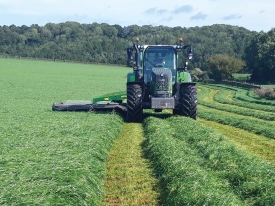
Let’s use Barmix to see how that works. Why has it become such a bestseller? Primarily down to its persistency, resilience, and flexibility. Early growth in the spring? That’s the modern cocksfoot and timothy it contains. Quality and protein? White and red clover. Winter tolerant? Tall fescue and timothy. Drought-tolerant? Thank the tall fescue again. And underlying it all, allowing a Barmix-sown field to double-up as both spring grazing and silage or hay, are familiar ryegrasses like Gracehill.
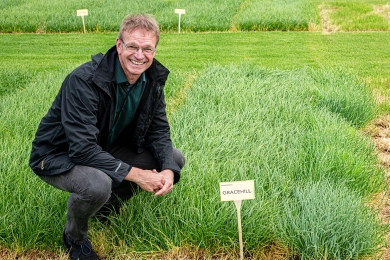
That tells another story. Gracehill, along with nearly 50 other grass varieties, arose from our collaboration with AFBI in Northern Ireland. It’s always exciting when we can add those fresh, new varieties to our mixtures. In 2024, we had the opportunity to strengthen our range with the addition of ryegrasses like Killylea and Tollymore – UK-bred varieties, grown in the UK with UK trial data, designed for UK farms.
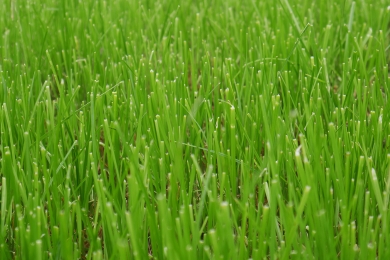
What Barmix also demonstrates is Barenbrug’s knowledge of how different species and different varieties perform in concert. Constructed well, mixtures should magnify the characteristics of each component so that you end up with a sward that is very much more than merely the sum of its parts.
Whether it’s ryegrass or timothy, legumes like clover and lucerne, or herbs such as chicory or yarrow, be assured that when you see them on a mixture label they’ve been selected for their unique contribution. Think again about that tall fescue in Barmix, selected for its amazing abilities to keep going through dry periods. Every hero has a superpower, and for tall fescue it’s the length of its roots. At 1.5m, they go ten times as deep as ryegrass. Great for finding moisture, and amazing for bringing up nutrients too.
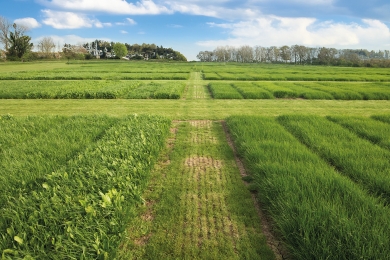
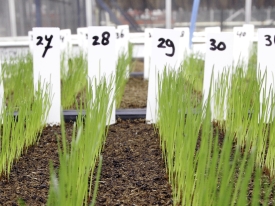
One further thing that goes into each bag of every Barenbrug mixture is the assurance of quality. Our particular focus is on performance metrics, which are tested and recorded at Barenbrug’s Cropvale Research station in Worcestershire. Then it’s over to our dedicated UK seed growers: experienced and trusted, they grow over 3,000ha of our seed every year.
Growing locally allows us to keep an eye on quality standards, ensuring our confidence in the quality of every bag of Barenbrug seed that ends up on a UK farm. And as it’s the expectation of quality that keeps UK farmers coming back to Barenbrug for their grass, it’s an honour for us to oversee this range, and maintain that expectation. Plus – knowing what we know about what’s in the pipeline, it’s our opinion that things can only get better!
Related information
Barmix
-
A multispecies grass mix, providing benefits from diverse grass rooting structures
-
Tolerant to periods of dry conditions
-
For cutting & grazing