Wet Winter, Weaker Swards? Assessing the Damage and What to Do Next
David Linton, Agriculture Commercial Manager
If you’re anything like me, you probably raised an eyebrow at the Met Office stats released at the end of February 2026.
‘Wetter than average’, read the headline. ‘Not record-breaking’, the sub-title added.
It suggested the old aphorism: there are lies, damned lies, and statistics. That said, I don’t envy the Met Office statisticians: how exactly do you calculate the average rainfall across the country for the 90-odd days of winter?
In fact, that national average neatly conceals the fact that if you’re an English farmer, then your fields have likely received around 42% more winter rain than the long-term average – making it the wettest winter for more than a decade. Spare a special thought for Cornwall – its January rainfall of 267.6mm was the wettest on record.
Now, here’s the thing. What does that amount of rainfall weigh? And what effect does that have on a pasture?
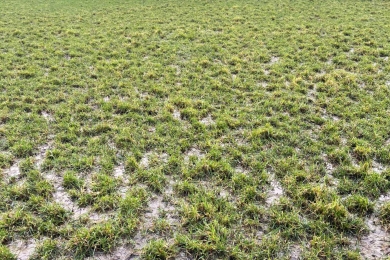
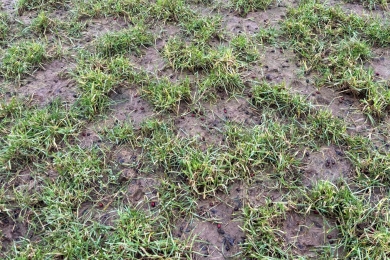
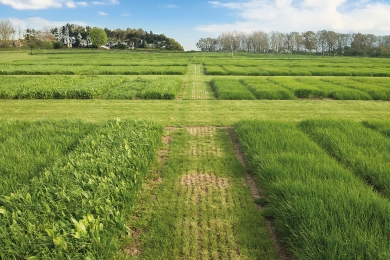
I started thinking about this, when I received a set of pictures from one of our customers. This is what happens with record-breaking rainfall. 1mm of rain? That’s one litre of water, spread over one square metre. One litre of water weighs 1kg. So 1mm of rain, over a hectare – that’s 10,000 litres, a weight of 10 tonnes.
But 267mm of rain? That’s just delivered 2,670 tonnes of water across one hectare of pasture. That’s a lot of compaction, on very waterlogged soil.
And that’s what’s happened here. The soil’s waterlogged. It’s been further compacted by sheer weight of rain. The most vulnerable species – the perennial ryegrass – in this field of Barmix has simply perished. Its shallow, finer roots haven’t been a match for the deeper rooting structures of timothy and tall fescue.
Remedial action
This field’s an extreme but there’ll be many more fields that – while not as severe as this – will likely be displaying ‘sub clinical’ symptoms that stem from waterlogged soil and compacted soil profiles.
What’s the remedy?
First step is our old friend, the pasture index. Get out there, inspect the fields, and use the pasture indexing to quantify what attention and actions each field will need. There’s also a more immediate benefit in identifying which fields will be available to use for early turn-out, versus those that will need time for remedial action to take effect.
The field shown in these photos will clearly need overseeding to ‘reinsert’ the PRG element that’s been lost over winter. But with the ground closed over as it is, there’ll be little chance of good establishment without first opening it up.
So, hand-in-hand with the field indexing, it’s also worth considering which fields could benefit from aeration and drainage – perhaps a pass with a subsoiler, or one of the more specialist grassland tools like the ‘sward lifter’ or ‘panbuster’. Typically this would be an autumn operation, allowing plants to repair the tines’ slicing damage during winter.
But desperate times call for desperate measures: compacted soil means poor drainage, which will stop soils warming up, stunt grass growth and put fields at greater risk of poaching – none of which is very attractive, if other fields are already in ‘special measures’ while other winter damage is repaired.
(It’s also worth considering – as a pro-active measure – if you can incorporate pre-emptive sward-lifting into your autumn schedule, in a bid to keep pastures ‘rainfall-ready’ in the event of another wet winter.)
Stick to the plan
‘No plan survives first contact with the enemy’, goes the old saying. But that’s a little misleading: a good plan recognises that things change. A good plan accommodates change and still allows you to emerge victorious.
That should be the nature of your grassland plan – one that focuses on growing more grass of the best quality, while incorporating enough resilience, contingency and preparedness to ensure you reach that target regardless.
Think ‘if this, then that’, and you’ll be on the right track – with a weight off your mind (if not off your fields).